Florida First Class Villas manages vacation rentals in Cape Coral for a 20 percent all-in fee, with no onboarding cost and no markups on maintenance or services. Your property goes live within 5 business days after approval, and the agreement is cancellable after 12 months. One local team, based in Southwest Florida.
Cape Coral property management has changed in 2026. Casago bought Vacasa, the fee floor for full-service local managers has tightened, and the city tightened its short-term rental rules on January 1. The result for owners: more choice, more clarity if you know where to look, and a real cost to staying with the wrong manager.
Inside that 20 percent sit the OTA fees, the Tourist Development Tax handling on every booking, direct and OTA, and one local point of contact instead of a franchise lottery. This page covers what is in the fee, what the current Cape Coral market is doing, and where the trade-offs sit if you are evaluating a switch.
What full-service Cape Coral property management includes
You keep ownership. You see the numbers. Florida First Class Villas runs the operation. The 20 percent fee covers every step between the signed agreement and the monthly net deposit, with no markups on top.
That covers listing setup and photography coordination, channel distribution across Airbnb, Vrbo, Google Vacation Rentals and the Florida First Class Villas direct booking site, daily dynamic pricing through Beyond, 24/7 guest communication, cleaning coordination after every checkout, routine maintenance oversight, and Tourist Development Tax remittance for Lee County on every booking. Vacation rental management fees are kept inside the headline percentage.
Monthly owner statements show revenue, occupancy and any maintenance cost against a single management fee line. Permit renewals are tracked. The work that Cape Coral airbnb management requires daily, the inquiry messages, the cleaner schedules, the broken AC at 9pm, the guest who locked themselves out, runs through one local team rather than a national queue.
The 20 percent fee, what it actually covers
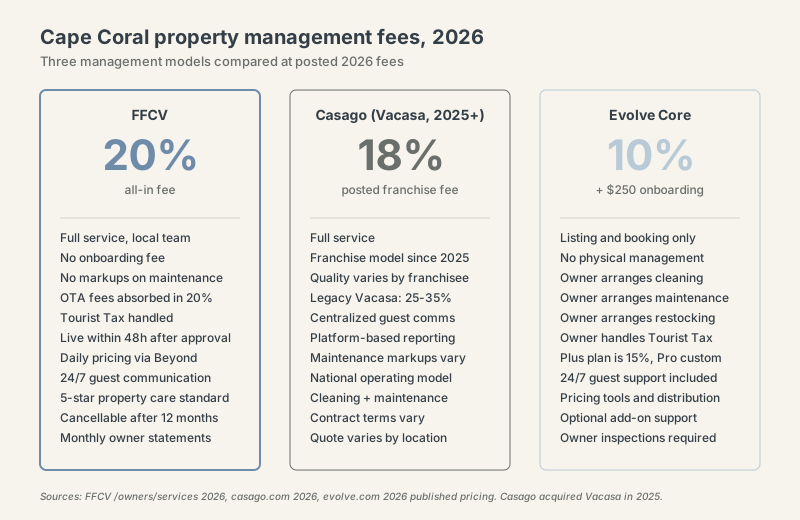
Most owners evaluating a vacation rental manager Cape Coral compare four numbers: the percentage, the onboarding cost, the cancellation clause, and what sits on top of the headline fee. Florida First Class Villas charges 20 percent of booking revenue, all in. No onboarding fee. No setup charge. No markups on maintenance or services. OTA platform costs are included. The contract is cancellable after 12 months.
For context on the rest of the market: Casago acquired Vacasa in 2025 and now operates the former Vacasa portfolio as a franchise network, so service quality varies by local franchisee. Listing-only providers advertise a lower headline percentage, but cleaning, maintenance, restocking and on-the-ground guest support stay with the owner.
A 20 percent full-service fee against a 10 percent listing-only fee is not a fee comparison. It is a workload comparison. Under a listing-only structure you pay less and absorb every operational issue. Under full service you pay more and absorb almost nothing operational. The right answer depends on how much time you have and how far from Cape Coral you live.
Cape Coral vacation rental market in 2026
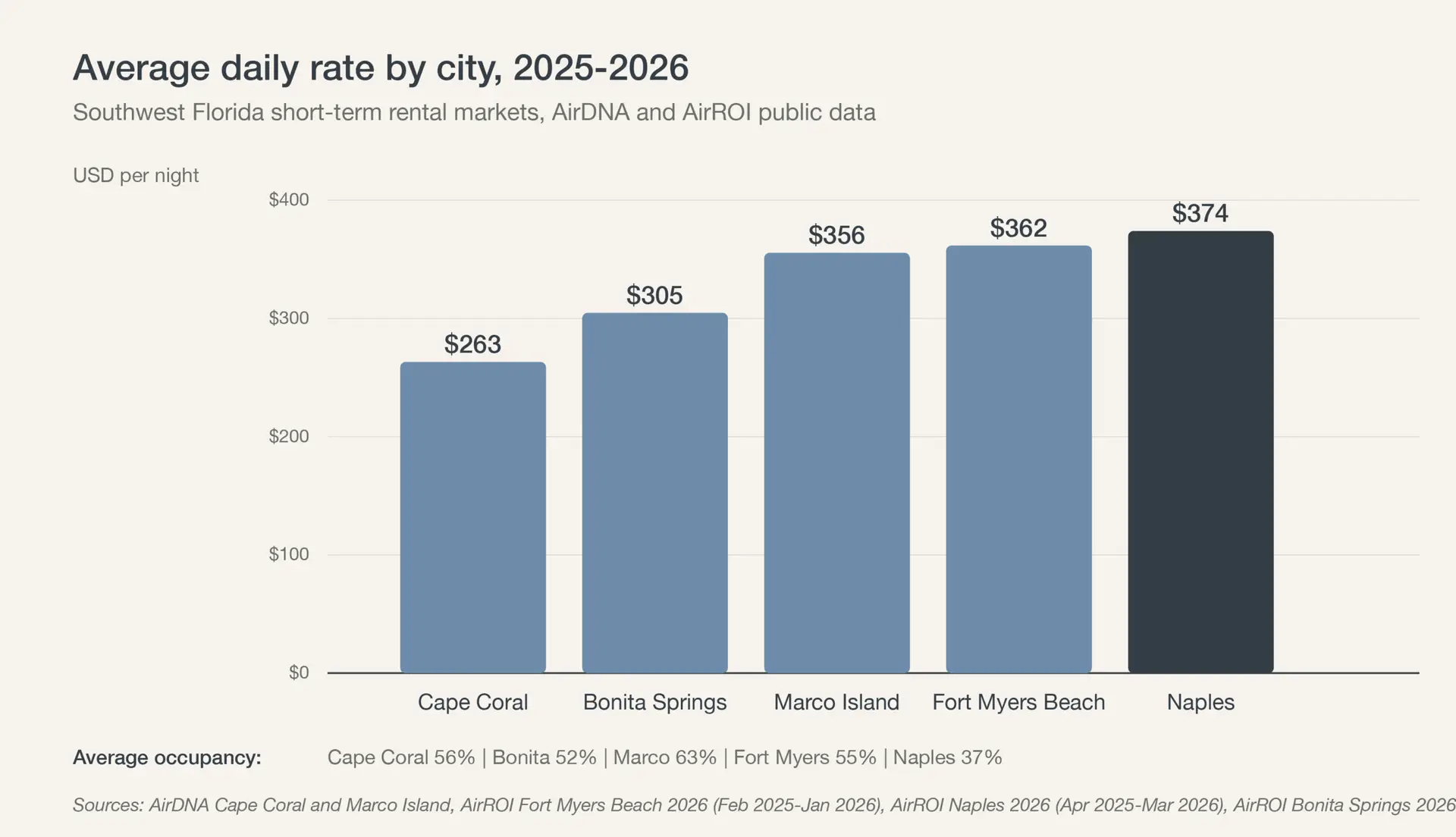
The average Cape Coral vacation rental grosses about $41,690 a year, at an average daily rate of $257.47 and 58 percent occupancy. Across the wider Cape Coral and Fort Myers market AirDNA counts 11,826 active listings, an average daily rate of $276.39 and an average gross of $44,984 per home per year.
Professionally managed homes price above the market as a whole. In the Cape Coral and Fort Myers market the average daily rate for professionally managed properties is $335.82, against $276.39 market-wide. March is the strongest month here and September the weakest.
The spread between the bottom and the top of the market is wide. Across the four Southwest Florida markets the 25th percentile home grosses roughly $17,000 to $24,000 a year, while the 90th percentile grosses $70,200 to $121,400. Two comparable homes on the same street can produce very different annual income, and the difference is usually pricing discipline and review consistency. For the full city-by-city breakdown, see the average Airbnb income Southwest Florida report.
Source: AirDNA, 27 June 2026, Southwest Florida market averages. These figures are Southwest Florida market averages from AirDNA (June 2026), measured across many different properties. Every home is unique. Actual income depends on location, size, condition, amenities, management and seasonality, so individual results vary. Use this as a market reference, not a guarantee or a forecast for any specific home.
2026 short-term rental registration in Cape Coral
Cape Coral adopted Ordinance 53-25 and Resolution 279-25 in late 2025. They took effect on January 1, 2026. Every short-term rental property in the city now needs annual registration with the City Clerk for a $350 fee. Long-term rentals (more than six months) pay $35 annually.
Enforcement tightened at the same time. The first violation now carries a fine of up to $1,000. Repeat violations can reach $2,000. Operating an unregistered short-term rental, or registering as a long-term rental while operating short term, both trigger enforcement. Online registration is at capecoral.gov/RentalRegistration. The cape coral short term rental permit guide walks through the full registration steps for new properties.
How owner onboarding works at FFCV
The Florida First Class Villas onboarding process is structured in four steps. The property goes live within 5 business days after approval, not weeks. The four steps:
- Step 1, property review and fit check. We verify the home matches Cape Coral demand patterns and current local regulations. No commitment yet.
- Step 2, setup and registration. Listings, pricing system, channel connections and compliance documentation are configured. City registration and Florida DBPR vacation rental license are confirmed or filed.
- Step 3, go live. The property becomes bookable across Airbnb, Vrbo, Google Vacation Rentals and the Florida First Class Villas direct booking site. Pricing activates immediately.
- Step 4, performance monitoring. Daily pricing updates via Beyond start with the first booking. Adjustments continue based on booking pace and competitor occupancy.
Existing reservations transfer cleanly when an owner switches from another short term rental management Cape Coral provider. Current guests are not affected. Bookings get re-mapped, calendars get linked, payouts get redirected. The transition is administrative on the back end.
Managing a Cape Coral property from outside Florida
Many of the vacation rental properties in Lee County are owned by people who do not live in Florida. The choice for those owners is between managing remotely, which means handling messages, vendor calls and emergencies from a different time zone, or working with a local manager who handles all of it on the ground.
Airbnb management Cape Coral for out-of-state and overseas owners means the local Florida First Class Villas team is the contact point for guests, cleaners and maintenance providers. You receive monthly statements and can access booking data. You do not need to be available when a guest reports a pool heater issue at 9pm. That is handled. For owners based outside the US, the managing Florida vacation home from Europe guide covers time zone logistics, payment structure and what to expect from month-to-month reporting.
Local team versus franchise model
The Casago acquisition of Vacasa changed the operating model for a large share of professionally managed vacation rentals in the US. Properties under the Vacasa brand now sit inside a franchise network. That can work well when the local franchisee is strong. It can work less well when the franchisee is new, understaffed, or covers too wide a geography to know your property personally.
Florida First Class Villas is not a franchise. The team is based in Southwest Florida, and the people managing your property have walked through it. That matters when a guest reports a dock line issue at Tarpon Point on a Friday afternoon, when a permit renewal comes up for a property near the Yacht Club, or when a tropical system tracks toward Lee County and shutters need to go up. Local presence is not a marketing phrase. It is the difference between a problem resolved in hours and one that waits for a national queue.
If you are considering switching from a current manager, the switch vacation rental manager guide covers what to check in your contract, how to protect existing bookings, and what a clean handover looks like. Homes in Fort Myers, Naples, Bonita Springs and Estero are managed by the same local team under the same fee structure, and our management services page sets out exactly what that includes.
Cape Coral 2026 market context
Lee County tourism data published by the Lee County Visitor and Convention Bureau and AirDNA both point in the same direction for 2026: stable demand, growing supply, and a widening gap between the top and bottom of the market. That gap is good news for owners with a manager who actively prices, refreshes listings and protects review scores. It is bad news for owners with a static listing and no active oversight.
The properties that hit the top of the market share three things: pricing that responds to real demand, a clean and complete listing that converts inquiries, and a service standard that produces 4.8 or higher ratings on Airbnb and Vrbo. Those three are exactly the work that full-service management is meant to deliver. If your current setup is missing one of the three, the gap shows up in the monthly revenue figure.
Property care beyond rentals
If your Cape Coral property also needs care when it is not rented, our sister company Suncoast Property Care handles home watch, maintenance and year-round care across Southwest Florida. See suncoastpropertycare.com for certified home watch and full property care services.
Looking for vacation rental management in Cape Coral? Request a free property review and see what your home can realistically earn under local professional management.